Facial Profile Analysis: What to Expect

Facial profile analysis is a structured review of how the forehead, nose, lips, chin, jawline, and neck relate in side view. It does not produce a universal “ideal”; it helps you and a qualified clinician describe proportions, priorities, and realistic options while keeping the whole face in context.

What Is Facial Profile Analysis?
Facial profile analysis examines the face from the side rather than judging one feature in isolation. A clinician may observe the forehead slope, nasal projection, lip position, chin projection, jaw contour, and chin-to-neck transition, then consider how these elements relate to your front and three-quarter views.
The goal is not to force everyone toward one formula. Age, ancestry, sex characteristics, expression, dental relationship, soft-tissue thickness, and personal preference all influence how a profile is perceived. A useful assessment therefore describes relationships and trade-offs instead of labeling a face as “correct” or “incorrect.”
According to a Journal of Maxillofacial and Oral Surgery study indexed by PubMed (2026), researchers asked 135 randomized participants to rate 18 neutral profile images. The results showed that jaw relationships affected ratings, but the study used simplified black-and-white images and a modest sample, so it cannot define an ideal for an individual person.
That limitation matters. Population averages can inform research, yet they cannot replace your own goals or a clinical examination. This is also why a thoughtful discussion of facial symmetry and proportion treats balance as context, not a score.
Which Features Are Reviewed Together?
A profile assessment usually starts with landmarks, but the interpretation comes from their relationships. The forehead creates the upper frame; the nose occupies the center; the lips and chin shape the lower-face outline; and the jaw-to-neck angle completes the silhouette.
Teeth and bite can influence lip support and jaw appearance. A surgeon may therefore recommend dental or orthodontic input when the concern appears connected to the jaws or bite rather than to facial soft tissue alone. This is not a diagnosis from a photograph.
According to a 2026 cross-sectional study indexed by PubMed, researchers assessed facial soft-tissue profiles in 120 orthodontic patients and found differences in lip prominence and the angle beneath the nose across bite groups. The single clinical sample and observational design limit how broadly those findings apply, but they reinforce why profile review should include dental relationships.
The neck also changes the reading of the lower face. Posture, camera height, lens distance, and head rotation can make a jawline appear sharper or softer. Standardized photographs reduce those distractions, but they do not replace an in-person examination.
How Is a Facial Profile Analysis Performed?
A responsible facial profile analysis combines standardized images, your stated goals, clinical observation, and—when appropriate—measurements. The process commonly follows these steps:
- Clarify the concern. Describe what you notice without naming a treatment: for example, “I want to understand why my lower face looks different from the side.”
- Capture consistent views. Use a neutral expression, level head position, even light, and a camera placed far enough away to reduce wide-angle distortion.
- Review the whole outline. Compare forehead, nose, lips, chin, jaw, and neck together in front, profile, and three-quarter views.
- Check function and history. Discuss breathing, bite, prior facial procedures, dental care, medical conditions, medicines, and healing history with the appropriate clinician.
- Separate observations from options. An observed proportion does not automatically call for a procedure; several approaches—or no treatment—may be reasonable.
- Agree on realistic priorities. Ask what would change, what would stay the same, and which uncertainties cannot be predicted from photos.
You can explore overall balance with the live Glow Up preview before a consultation. A preview can help you find words for a preference, but it cannot assess anatomy, candidacy, risk, or a likely surgical result.
What Should You Bring to a Profile Consultation?
Bring consistent photos, a short priority list, your relevant health history, and questions about function, limits, risks, and recovery. One or two references can be useful when you explain the specific quality you like, but asking to copy another person’s face is neither realistic nor respectful of your anatomy.
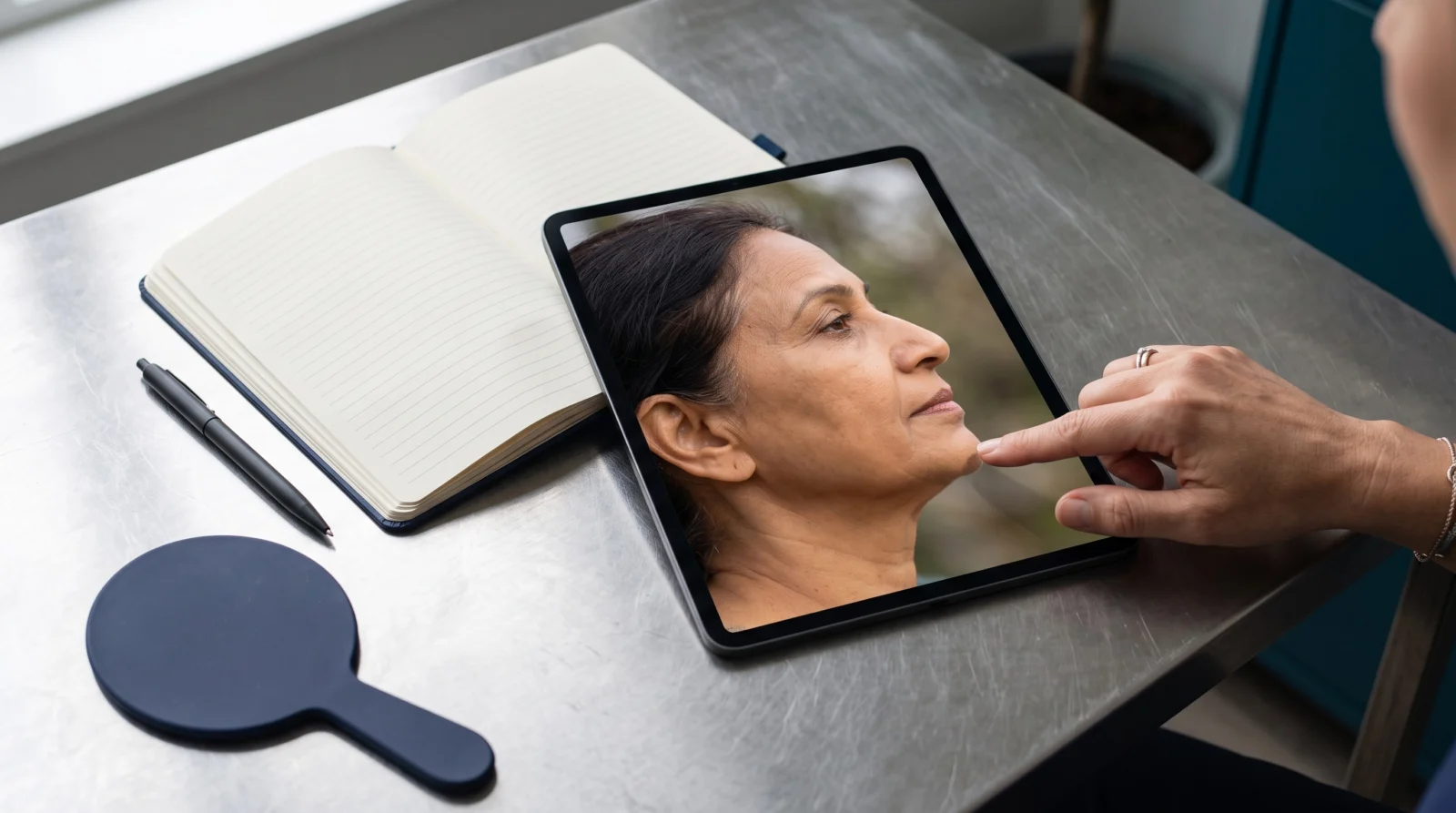
Use this preparation sequence:
- Save one front, one true profile from each side, and one three-quarter photo in similar light.
- Write your top concern and one feature you do not want changed.
- List prior facial or dental care, current medicines, allergies, and healing issues accurately.
- Ask who will perform the procedure, what qualifications they hold, where care occurs, and how complications are handled.
- Take notes about alternatives, recovery milestones, total costs, and follow-up.
For a broader checklist, see how to prepare for a plastic surgery consultation. If the profile discussion centers on lower-face projection, this guide to chin augmentation and rhinoplasty for profile balance explains why changing one feature can alter how another is perceived.
How Should You Interpret a Digital Preview?
Treat a digital preview as a conversation aid, not a forecast. It can make a vague request more concrete—such as preferring a softer chin-to-neck transition or preserving a strong profile—but it cannot show tissue behavior, scars, swelling, healing, or technical feasibility.
The American Society of Plastic Surgeons statistics page reported (2025) that facial fat grafting increased 39 percent among its tracked surgical procedures, while several other face-focused operations also rose. That professional-body snapshot supports current interest in integrated facial planning, although member-reported procedure totals do not reveal what is appropriate for any one person.
When reviewing an image, ask whether only the requested region changed, whether lighting and expression stayed consistent, and whether the result still looks like you. The Plastic Surgery AI app can visualize facial changes on your photo; use the result to discuss preferences with a board-certified surgeon, not to self-diagnose or select a procedure.
A good consultation may conclude that no procedure is needed, that further dental or medical assessment comes first, or that the safest option differs from the picture you brought. The value of analysis lies in clearer questions and informed consent, not in reaching a predetermined treatment.
FAQ
Is facial profile analysis a diagnosis?
No. It is a descriptive planning method, while diagnosis and candidacy require an appropriate licensed clinician, medical history, and examination.
Can facial profile analysis be done from one photo?
One profile photo can start a discussion, but it can be distorted by lens distance, posture, head rotation, and expression. Clinicians generally need several standardized views and an in-person assessment.
Does everyone need mathematically equal facial proportions?
No. Proportion rules are reference tools, not universal beauty standards, and natural variation is normal across individuals and populations.
Can an AI preview predict my result?
No. It visualizes a possible look but cannot model anatomy, surgical technique, healing, risk, or outcome; consult a board-certified surgeon for individualized guidance.
AI previews are visualizations, not medical advice.