Bilateral Blepharoplasty: Upper, Lower, or Both?
Bilateral blepharoplasty means treating both eyes; learn how upper, lower, and combined plans differ, plus recovery, risks, and questions.
On this page
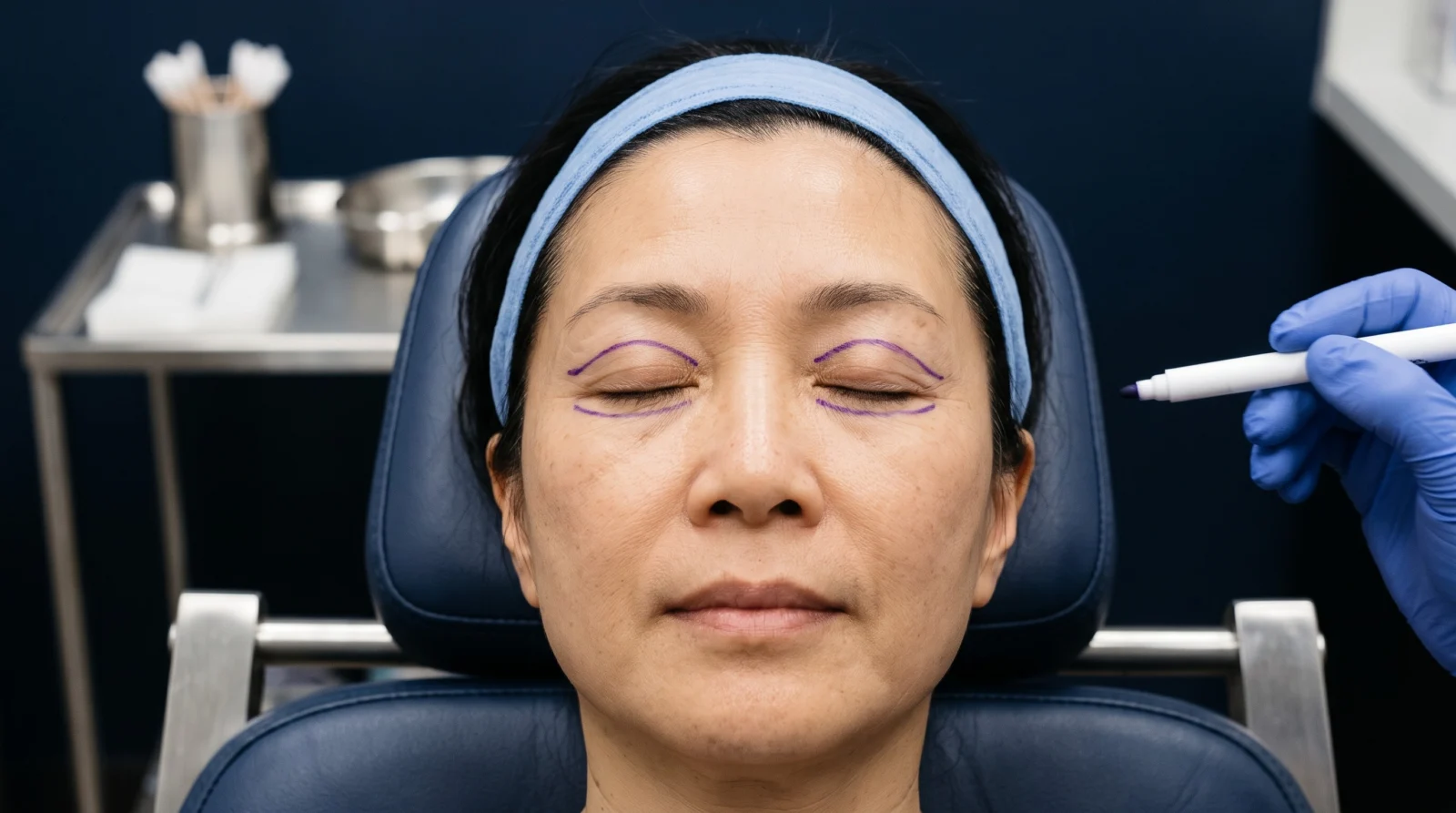
Bilateral blepharoplasty means eyelid surgery performed on both eyes during the same operative plan. It may involve both upper lids, both lower lids, or all four lids, depending on the concern and examination. The word “bilateral” describes the two-sided approach; it does not identify which eyelid level is treated.

What does bilateral blepharoplasty mean?
It means corresponding eyelids on the right and left are treated in one planned operation. A surgeon may recommend bilateral upper surgery, bilateral lower surgery, or a combined upper-and-lower plan. Treating both sides together does not mean removing identical amounts from each eye.
Most faces have natural asymmetry. One brow may sit higher, one lid crease may differ, or one lower lid may have more skin laxity. The operative design should account for those differences rather than force mirror-image treatment.
The term can also appear in medical records when surgery is intended to improve a restricted upper field of vision. Whether the purpose is functional, aesthetic, or mixed should be stated separately. Ask the surgeon to identify each planned lid on a diagram and explain the goal for each side.
For a broader overview of eyelid topics, the eyes and brows hub collects related guides in one place.
Is bilateral blepharoplasty upper, lower, or both?
Bilateral describes the sides, not the eyelid level. “Bilateral upper blepharoplasty” means both upper lids; “bilateral lower blepharoplasty” means both lower lids. A four-lid plan treats both upper and both lower lids in the same session.
| Plan | Main area assessed | Common planning focus | Recovery consideration |
|---|---|---|---|
| Bilateral upper | Both upper lids | Skin excess, lid crease, brow position, visual-field symptoms | Upper-lid swelling and incision care |
| Bilateral lower | Both lower lids | Under-eye bags, skin support, lid tone, cheek-lid transition | Swelling may extend into the upper cheeks |
| Upper and lower | All four lids | Balance across the entire eye area | A wider treatment area may mean more visible early swelling |
Upper-lid heaviness can sometimes relate partly to brow position. The guide to upper blepharoplasty versus brow lift explains why a surgeon examines the forehead and brows before deciding what the upper lid itself needs.
Lower-lid planning is different. The surgeon assesses lid support, eye prominence, fat position, skin quality, and the transition into the cheek. The aim is not simply to remove as much tissue as possible; excessive removal can create functional and contour problems.
How is a bilateral eyelid plan made?
The safest plan comes from an in-person examination with a suitably qualified, board-certified surgeon who regularly performs eyelid surgery. Photos and visualizations can organize questions, but they cannot test lid tone, tear production, vision, or tissue support.
- Define the concern. Describe whether the issue is upper-lid heaviness, lower-lid bags, asymmetry, visual obstruction, or a combination.
- Review eye health. Disclose dry-eye symptoms, previous eye procedures, vision changes, medicines, allergies, and relevant health conditions.
- Examine each side separately. The surgeon checks brow height, lid crease, skin, fat position, lower-lid support, and pre-existing asymmetry.
- Confirm the exact scope. Ask whether the written plan covers two upper lids, two lower lids, or all four lids, and whether another eyelid procedure is proposed.
- Plan recovery and support. Confirm transport, help at home, follow-up dates, eye-care instructions, and the symptoms that require an urgent call.
You can review face-focused options on the procedure exploration page. The Plastic Surgery AI app provides an AI visualization on your own photo to help you prepare questions for a consultation with a qualified professional — not medical advice and not a prediction of results.
What should you expect after bilateral blepharoplasty?
Swelling, bruising, tightness, temporary blur from ointment, watering, and light sensitivity can occur early. Follow the surgeon’s instructions about cold compresses, head elevation, prescribed eye care, contact lenses, driving, work, and exercise rather than relying on a universal timetable.
The American Society of Plastic Surgeons’ eyelid recovery guidance notes that lubricating ointment, cold compresses, and loosely applied gauze may be used during initial healing. Your own instructions take priority because technique and eye health vary.

A return to screen work is not the same as complete healing. Bruising may improve before swelling and incision color fully settle. If only the upper lids are treated, this upper blepharoplasty recovery timeline gives more focused planning context; lower-lid patients can use the separate lower blepharoplasty recovery timeline.
Seek urgent medical advice for severe or rapidly worsening pain, sudden vision change, increasing one-sided swelling, marked bleeding, chest symptoms, or any concern listed in your discharge instructions. Do not wait for a routine follow-up when vision is affected.
What do studies say about risks and symmetry?
Every operation has risk, and treating both eyes does not guarantee perfect symmetry. Relevant concerns include infection, bleeding, dry or irritated eyes, visible scarring, difficulty closing the eyes, lid-position change, contour irregularity, asymmetry, and the possible need for further treatment.
According to a systematic review in Aesthetic Surgery Journal (2025), researchers analyzed 36 articles on lower blepharoplasty complications and described an overall low complication profile. However, the authors called for more rigorous comparisons, so the review should not be read as a personal risk estimate.
According to a six-patient case series in Ophthalmic Plastic and Reconstructive Surgery (2024), transient pigmentation along eyelid suture lines was identified one to four weeks after surgery and was managed conservatively. The series was very small and described a rare finding, so it cannot establish how often this occurs.
Ask how the surgeon documents asymmetry, protects the eye surface, selects incision placement, and decides how much tissue to preserve. A board-certified surgeon should also explain their own complication and revision approach in language you understand.
FAQ
Does bilateral blepharoplasty always treat all four eyelids?
No. Bilateral means both sides; the operative note must specify upper lids, lower lids, or both levels.
Are both eyelids treated exactly the same way?
Not necessarily. Natural asymmetry may require slightly different markings or tissue adjustment on each side while working toward balanced, not mathematically identical, results.
Can upper and lower eyelid surgery be done together?
They can be combined for some people, but the decision depends on eye health, lid support, goals, anesthesia planning, and the surgeon’s examination. Consult a board-certified surgeon for an individualized risk discussion.
How long before swelling settles?
Early swelling often changes noticeably over the first days and weeks, while subtler settling can take longer. Your surgeon’s timeline is more useful than a fixed online estimate because the scope and technique differ.
Can an AI preview decide which eyelids need treatment?
No. A visualization cannot diagnose a condition, assess vision, or determine candidacy; those require an examination by a qualified professional.
AI previews are visualizations, not medical advice.
Sources & further reading
- Eyelid surgery (blepharoplasty) — American Society of Plastic Surgeons
- Brow lift — American Society of Plastic Surgeons
- Blepharoplasty — American Academy of Facial Plastic and Reconstructive Surgery
- Eyelid surgery — NHS
- Patient safety — American Society of Plastic Surgeons
- Find a board-certified plastic surgeon — American Board of Plastic Surgery
- Cosmetic procedures — NHS
Written by the Plastic Surgery AI editorial team. Educational information only, not medical advice; always talk to a board-certified surgeon. Our editorial policy.