Endoscopic Brow Lift vs Temporal Brow Lift
Endoscopic brow lift vs temporal brow lift: compare treatment areas, incisions, recovery, and consultation questions before choosing an approach.

On this page
Endoscopic brow lift vs temporal brow lift comes down mainly to treatment area: an endoscopic approach can reposition more of the brow and forehead, while a temporal approach concentrates on the outer brow. The right choice depends on brow shape, hairline, eyelid relationship, anatomy, and a surgeon’s examination—not on incision size alone.
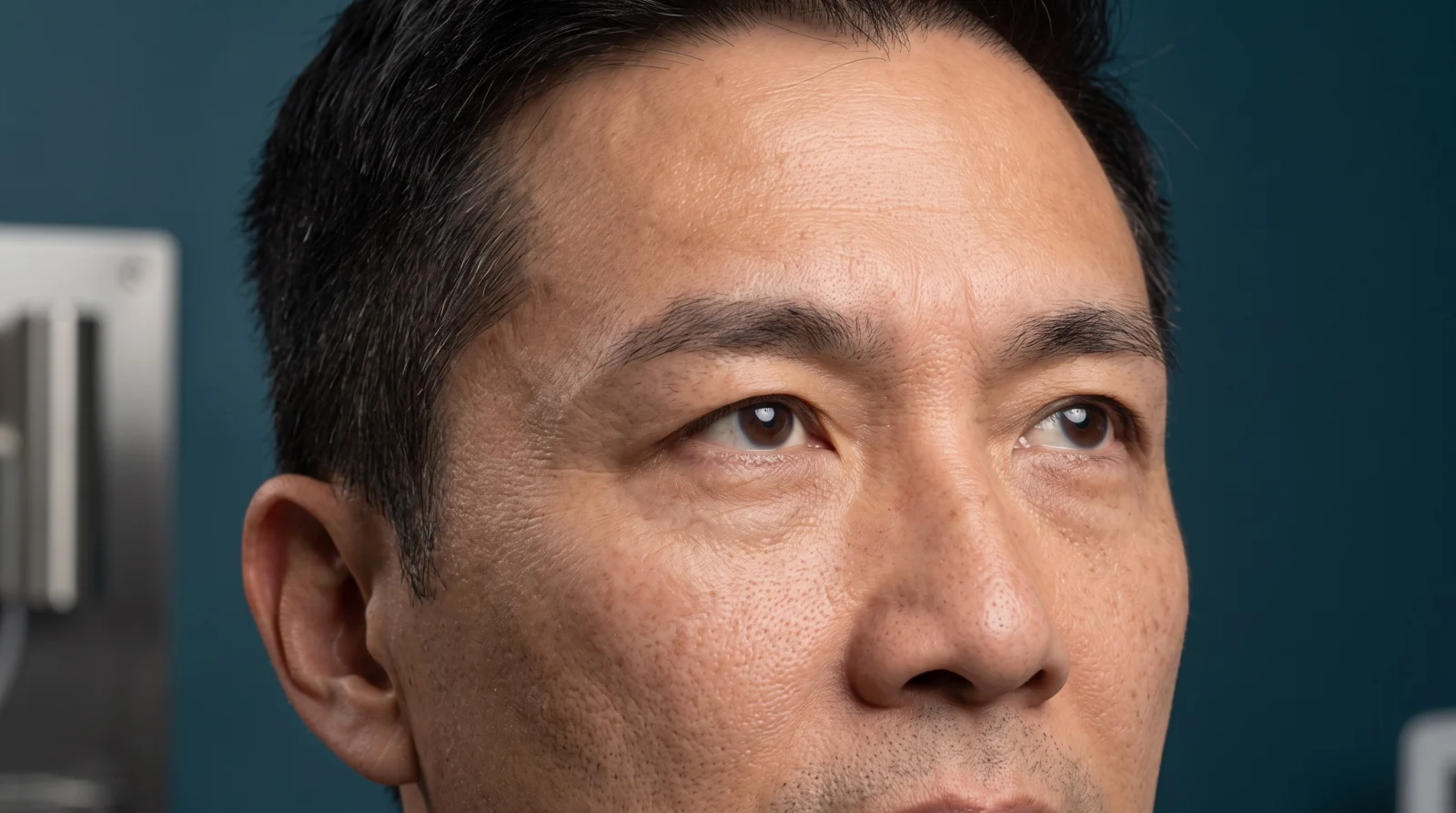
Endoscopic brow lift vs temporal brow lift: what differs?
An endoscopic brow lift generally uses several short incisions hidden in the hair-bearing scalp. A camera and instruments help release and reposition tissues across a broader part of the forehead. The exact dissection and fixation method vary by surgeon, so “endoscopic” describes access rather than one universal operation.
A temporal brow lift, also called a lateral brow lift, usually works through incisions near the temples. Its main emphasis is the outer third of the brow. It may suit a person whose central brow position is acceptable but whose brow tail has descended, although only an in-person examination can separate brow descent from eyelid skin excess.
| Question | Endoscopic brow lift | Temporal brow lift |
|---|---|---|
| Main treatment area | Central and outer brow, with broader forehead access | Outer brow and temple region |
| Typical access | Several short scalp incisions | Short incisions near the temples |
| Best-aligned goal | Broader brow repositioning or asymmetry planning | Focused elevation of the brow tail |
| Forehead effect | Can address tissues across more of the forehead | Usually less central-forehead change |
| Recovery pattern | Scalp tightness, swelling, temporary altered sensation may occur | Temple swelling, tightness, and temporary altered sensation may occur |
| Key trade-off | Wider treatment area, more extensive dissection | More focused scope, which may not address central descent |
Neither technique is automatically more natural or longer lasting. Results depend on diagnosis, vectors, fixation, tissue quality, healing, and whether the operation matches the actual source of heaviness.
Which areas does each brow lift treat?
The simplest distinction is broad versus lateral: an endoscopic lift can influence the central and outer brow, while a temporal lift is designed mainly for the outer brow tail.
The eyebrows are not a single straight unit. The inner brow, arch, and tail can sit at different heights, and facial animation changes all three. A surgeon should assess the face at rest and during expression rather than planning from one carefully posed photograph.
The upper eyelids also matter. Skin resting near the lashes may reflect eyelid tissue, brow descent, or both. Our guide to upper eyelid surgery versus brow lift explains why treating the wrong level can miss the concern or change expression more than intended.
Hairline position can alter the plan because scalp incisions and tissue movement may affect how forehead height is perceived. According to a review in Otolaryngologic Clinics of North America (2025), brow assessment should include brow position, upper-eyelid redundancy, and the hairline. That review compares several approaches, but it is a clinical overview rather than a head-to-head trial proving one method superior.
What does the evidence say about technique?
The evidence supports individualized planning more strongly than a universal winner. Brow-lift studies often differ in technique, fixation, follow-up, and outcome measurement, making simple claims about superiority unreliable.
According to a Plastic and Reconstructive Surgery study (2007), a retrospective comparison of 100 endoscopic procedures and 93 limited-incision nonendoscopic procedures found an average 4 mm brow elevation in both groups. The nonendoscopic operations averaged 30 minutes versus 50 minutes, but this was a single-surgeon retrospective series and did not specifically test every modern temporal method.
According to another Plastic and Reconstructive Surgery series (2004), 538 consecutive endoscopic patients were reviewed, and longer-term brow-height stability differed by fixation method. The research suggests that details inside the operation matter, although its older, nonrandomized design and technique-specific findings limit broad predictions for an individual patient.
The practical lesson is to ask what will be released, in which direction tissue will be repositioned, how it will be secured, and how success will be measured. The facial profile analysis guide can also help you think beyond one feature and discuss balance without treating a mathematical ratio as a prescription.
How long is recovery after each approach?
Visible swelling and bruising often improve over the first couple of weeks, but scalp or temple tightness, itching, and altered sensation can last longer; your surgeon’s technique and instructions set the meaningful timeline.

A smaller incision does not guarantee an easier recovery. The amount and plane of dissection, fixation, simultaneous procedures, health history, and individual healing all influence downtime. Ask when you may wash your hair, sleep flat, wear headwear, return to work, and resume strenuous activity.
Temporary numbness around the scalp or temple may occur because small sensory nerves are affected by dissection and swelling. New weakness, rapidly increasing swelling, severe pain, fever, vision changes, or wound concerns deserve prompt contact with the surgical team rather than online self-triage.
For a more detailed sequence, read the brow lift recovery timeline. It is a planning framework, not a substitute for the personalized aftercare instructions provided by your surgeon.
How should you prepare for a brow lift consultation?
Prepare to describe the change you want without prescribing the operation. A request such as “I want less outer-brow heaviness while keeping my natural expression” gives a board-certified surgeon more useful information than choosing a technique from social media.
- Take neutral photos. Use even light, keep the camera level, relax your forehead, and include front and three-quarter views.
- Separate concerns. Note whether heaviness feels central, lateral, eyelid-related, or present mainly during expression.
- Ask the surgeon to demonstrate the vector. A gentle manual simulation can show whether central or lateral repositioning better matches your goal, without promising a result.
- Discuss scars and hairline. Ask where incisions would sit with your hairstyle, hair density, and forehead height.
- Compare recovery plans. Request specific guidance for work, exercise, hair care, follow-up, and warning signs.
- Review credentials and alternatives. Ask how often the surgeon performs each approach, how complications are handled, and whether observation or a different plan is reasonable.
You can browse the eyes and brows topic hub for related preparation and recovery guides. The live procedure explorer can help organize face-focused options before an appointment.
A visualization can make a goal easier to discuss, but it cannot model tissue behavior, scars, healing, or surgical judgment. The Plastic Surgery AI app can be used once to explore a conservative visual direction and bring clearer questions—not a predicted result—to a consultation.
FAQ
Is a temporal brow lift less invasive than an endoscopic brow lift?
It is usually more limited in treatment area, but “less invasive” does not predict comfort, risk, or recovery for every person. Ask the surgeon to compare the planned dissection, fixation, and incision locations in your case.
Which brow lift is better for the outer brow?
A temporal approach is designed around the outer brow, while an endoscopic approach may also reposition it as part of broader forehead treatment. The better match depends on whether descent is truly lateral or extends toward the center.
Can a brow lift correct hooded upper eyelids?
It may reduce heaviness caused by brow descent, but it does not directly remove upper-eyelid tissue. A surgeon should evaluate the brow and eyelid together before recommending a plan.
Will either approach change my expression?
Any brow repositioning can affect expression if the height or direction is poorly matched. Conservative goals, examination during facial movement, and clear discussion of brow shape can reduce misunderstanding but cannot guarantee an outcome.
AI previews are visualizations, not medical advice.